
The Role of Sport Psychology in Baseball and Softball
Baseball and softball ask athletes to be sharp for a few seconds, then wait, then be sharp again. That stop-and-start rhythm leaves a lot of room for doubt, and it is exactly why the mental side of these sports is as trainable as a swing or a pitch.
Why baseball and softball are such mental games
Most sports keep athletes moving, and movement tends to quiet the mind. Baseball and softball do the opposite. A hitter waits through an inning in the dugout, steps in, and gets a handful of pitches to deliver. A fielder can stand for several minutes and then have one chance to make the play. A pitcher carries every decision alone.
That structure creates two challenges. First, there is time to think, and for many athletes that thinking drifts toward the last mistake or the next big moment. Second, the sport is a team game made of individual moments, so every player feels exposed when the ball is on them. Working with a mental performance coach to learn sport psychology tools helps athletes to use that space well instead of letting it work against them.
Failure is built into the game
Even the best hitters fail more often than they succeed. Remember, an excellent batting average in the MLB is .300+. Errors, strikeouts, walks, and missed signs are part of every game, which means the real skill is not avoiding mistakes. It is recovering from them quickly.
Sport psychology tools teach athletes a reset process they can repeat in the few seconds between plays. A common version has three parts: acknowledge what happened, release it with a physical cue such as a deep breath, a glove tap, or a step off the rail, and refocus on one specific task for the next pitch. The goal is a short memory without pretending the mistake did not matter.
This also changes the way athletes talk to themselves. Replacing harsh self-criticism ("I always do this") with useful, specific productive self-talk ("see the ball early, stay through it") keeps frustration from carrying over into the next at-bat or inning.
Routines that create focus on demand
Because the action comes in bursts, the best players learn to turn their focus on and off. A pre-pitch or pre-at-bat routine is the simplest way to do it. It might include a breath, a look at the target, a cue word, and a quick visual of the intended swing or pitch. The exact steps matter less than the fact that they are consistent, so the routine becomes a signal to the body and mind that it is time to compete.
Routines also protect athletes from the noise around them, whether that is a loud crowd, a runner in a scoring position, or a parent in the stands. Athletes who practice staying in the present moment, one pitch at a time, tend to make decisions faster and with less hesitation.
These skills are practiced the same way physical ones are: in bullpens, in batting cage sessions and in game-like situations, until they hold up under pressure.
Every position has its own mental demands
The same mental skills show up differently depending on where an athlete stands on the field.
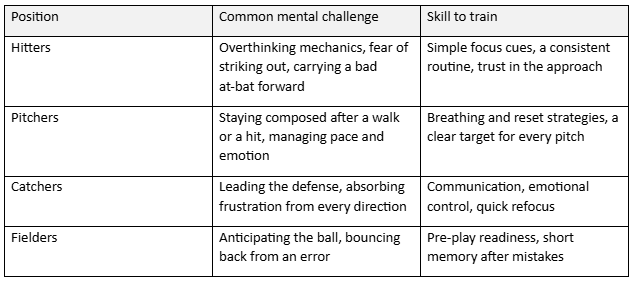
In softball, the speed of the pitching circle and the quick pace of the game leave even less time between moments, so quick, repeatable mental habits matter even more.
Slumps, the yips and rebuilding confidence
Every baseball and softball player eventually hits a stretch where nothing falls. Slumps are rarely just about mechanics. They usually grow from a loop of pressure, tension and overthinking that makes the next result more important than it needs to be.

The same is true of what players call the yips, when a once-automatic throw or pitch suddenly feels impossible. Mental performance work helps athletes break that loop by shifting attention away from outcomes and toward process, practicing under gradually increasing pressure, and rebuilding trust in skills they already own.
Confidence is not something athletes either have or lack. It is built from evidence: well-prepared practice, honest reflection on what went right, and the habit of noticing progress. Coaches who help players track those small wins give them something solid to lean on when results get tough.
How parents and coaches can help
The adults around a young athlete shape how failure feels. A few small habits make a real difference:
Ask about effort and learning after a game ("What did you focus on?") before asking about results.
Keep sideline feedback short and positive, and save corrections for practice or a calm conversation later.
Normalize mistakes by talking about how the best players handle them, not how rarely they happen.
Praise routines and preparation, so athletes learn to value what they can control.
When athletes feel safe to take risks, they play with more freedom, and freedom is where most great performances come from.
Train the mental game like any other skill
Baseball and softball reward athletes who can stay calm, focused and confident through a game of small moments. Those abilities are not talents some players are born with. They are skills, and they improve with the same kind of structured practice as hitting, pitching and fielding.
At Utah Sport Psych, we work with athletes, teams and coaches to build mental performance skills that hold up when it counts. If you are a player, parent or coach who wants to bring more focus and resilience to the diamond, reach out to start the conversation.