
Mental Performance Coach vs. Therapist: Which Does Your Athlete Need?
Your kid has a great practice, then falls apart in the actual game. Or you're an adult with a real job and a real training plan, and you still feel like you might throw up in the parking lot before every race. You Google "sports psychologist," "therapist for athletes," and "mental coach near me." Now you have twelve tabs open and no answers.
We get it. We're Utah Sport Psych, and we're mental performance coaches, we're not therapists or licensed psychologists. We say that first because it matters for everything below: we can explain the difference between coaching and therapy honestly, and we can tell you when the right answer isn't us.
The short answer
Mental performance coaching helps athletes build skills for performing under pressure. Therapy treats mental health concerns. They overlap in places, but they're not the same job.
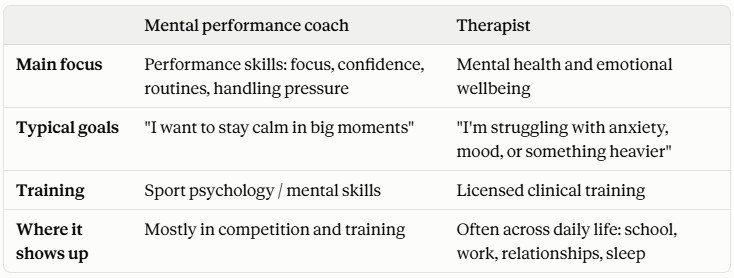
If your athlete's struggles show up mainly in competition, a coach is often a good fit. If they show up everywhere, start with a professional trained in mental health.
What a mental performance coach actually does
Yes, we teach breathing and we're here to say breathing is very important, but we can do more than that. Together, we work on skills athletes can practice like any other:
Creating a pre-performance routine so the first play isn't a total surprise to your brain
Helping your mind stay present and refocus through distractions or after a mistake.
Visualization (and yes, it works better than it sounds)
Building confidence in your abilities built on evidence, not vibes
Handling pressure without pretending nerves aren't there
We don’t coach the X’s and O’s of the game, but we do talk A LOT about your sport and how to apply these skills in a sport specific way.
What therapy does
Therapy is for mental health. A licensed therapist can help with anxiety, depression, trauma, grief, disordered eating, and other concerns that affect life on and off the field. Athletes deal with plenty of these things, and getting help for them is a strength, not a detour from training. Nothing about coaching replaces that, and we won't pretend otherwise.
"Do I need a therapist or a mental performance coach for competition nerves?"
Pre-competition nerves are normal, and most athletes have them. Your body is treating a big moment like a big moment. It's doing its job, just loudly, (…and you don’t need to “get rid” of those nerves, you can use them to your advantage).
If the nerves show up mainly before or during competition, and you otherwise feel fine, mental performance training is a good place to start. You’ll learn to work with the nerves, not wait for them to go away.
If the anxiety is spilling out of sport into school, sleep, friendships, or everyday life, or if it feels like more than nerves, talk with a therapist or your doctor. That's not a failure of mental toughness, it's just a different problem.
Mental performance coach vs. "sports psychologist"
People often use these terms interchangeably, and we understand why. Here's the honest version.
"Psychologist" is a licensed title, and we at Utah Sport Psych don't hold it. Our coaches have master's degrees in sport psychology and focus on teaching mental skills for performance. A licensed psychologist can diagnose and treat mental health conditions. Some also work with athletes on performance.
For most athletes, the practical question is usually: is this about performance, or about something bigger?
How to tell which one your athlete needs
If your athlete is struggling with anxiety, confidence or pressure, ask yourself:
Where do these feelings show up? Only in games and competitions? Or also at school, at home, and with friends?
Has anything changed in their life recently? An injury, a big loss, a move, a tough team situation? Sleep, appetite, mood, energy, or interest in things they used to love?
Are they avoiding their sport? Dreading practice, or making excuses to skip it?
How intense is it? Nervous and frustrated? Or panicked, hopeless, or shut down?
If the answers mostly point to "only in competition" and your athlete otherwise seems like themselves, a mental performance coach can help.
If the answers point to changes in daily life, start with a doctor, counselor, or therapist. If you're not sure, starting with a professional trained in mental health is a safe call. A good coach will tell you honestly if what they see is outside their lane.
If your athlete ever talks about hurting themselves or feeling hopeless, skip the checklist and get help now. In the U.S. you can call or text 988, the Suicide & Crisis Lifeline, any time.
A real-life example: a 12-year-old's pediatrician suggests a counselor because of game-day meltdowns, but she's a happy, well-adjusted kid the rest of the week. That's the type of situation where it helps to ask both: is this a mental health concern, or a skills gap around pressure? Some kids do great with a sport-focused coach. Others benefit from a counselor. Some need both. Your pediatrician's suggestion is worth taking seriously, and a coach can work alongside it.
Can they work together?
Absolutely. Plenty of athletes see a therapist for mental health and a mental performance coach for sport-specific skills, and the two can support each other. Coaches and therapists refer to each other all the time. We'd rather send you to the right person than keep you as a client for the wrong reasons.
What about talking to an athlete who's been through it?
Peer support is great. A college athlete who understands the pressure can be a comforting voice, and we're big fans of that kind of connection. But a peer, however wise, isn't trained to teach mental skills or to spot when something needs clinical care. Think of it as a good addition, not a replacement for either.
What the experts say
Professional organizations in sport psychology generally distinguish between performance-focused mental skills training and clinical mental health treatment, and they encourage practitioners to refer athletes to a licensed professional when a concern falls outside their training.
Ready to figure out which is right?
Not sure where your athlete falls? Find your coach and we'll help you sort it out. If the best fit is someone else, we'll say so. Prefer to talk it through first? Reach out for a free 15 minute consultation.
Dealing with an injury on top of everything else? Our Return to Sport Protocol is built for exactly that. For more on how our field compares with clinical psychology, see our post on sport psychology vs. clinical psychology.